Current Affairs
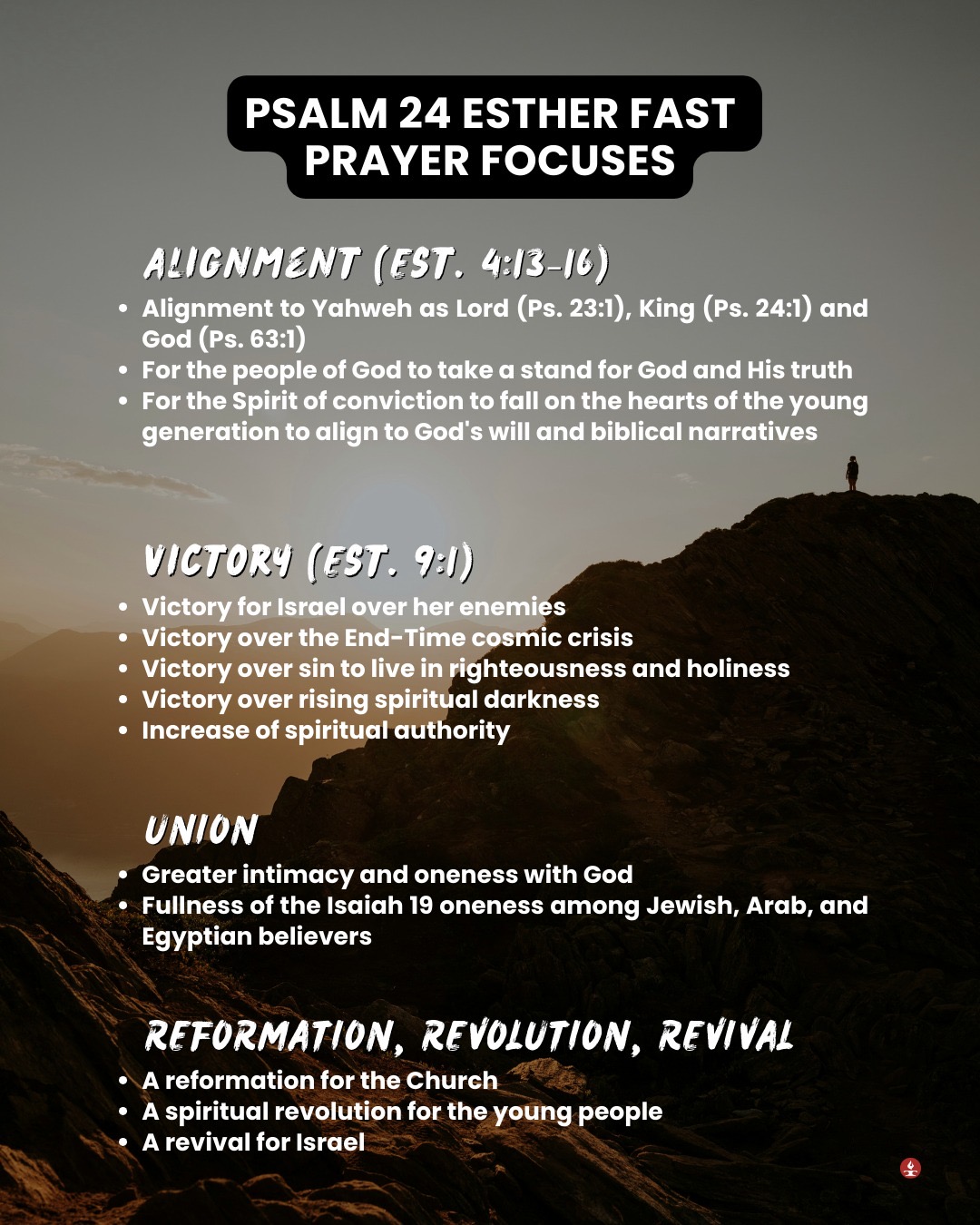
On 7 October 2023, Hamas initiated an unprecedented attack on Israel, throwing her into crisis. Since then, antisemitism has been on the rise globally. It is crucial for the Gentile Church to arise and stand in the gap to pray for Israel and the Jewish people in this hour.
- What is Happening in Israel? (Apr 2023)
- Prayers for Israel in Crisis (Oct 2023)
- Prayers for Israel and Iran (9 Av 2024)
General Themes to Pray for Israel

The Isaiah 40 Message Prayer for Israel Through Understanding the Mo’edim of God The Jerusalem Council Understanding the Isaiah 6 Holy Seed Salvation of Israel Hephzibah: Israel’s Identity and Destiny One New Man The Peace of Jerusalem The Aliyah The End-Time Prayer Movement for Israel Isaiah 19 The Role of the Church to Stand with Israel Prophetic Promises and Prayers for Israel







 :: HISTORIC :: STRATEGIC :: PROPHETIC ::
 There is only one way to eternal life, and that is through calling on the name of Jesus as Lord and Saviour. The Jewish people are not automatically saved for being the physical descendants of Abraham. Their zeal and their righteous acts cannot lead them to salvation. Salvation for them too is only by grace by faith in Yeshua Hamashiach (Jesus the Messiah).
 A majority of Jewish people are proud of their heritage and follow the traditions and feasts of their forefathers. Whether they know it or not, these traditions that they follow, like the Feasts of Passover (Pesach) and Tabernacles (Sukkot), all point to God’s salvation for them in Yeshua Hamashiach (Jesus the Messiah).
 There is only one city explicitly mentioned by name in Scripture that God calls us to pray for — Jerusalem. In Psalm 122:6, God’s people are exhorted to “pray for the peace of Jerusalem.”
 The Biblical definition of peace is not just about an absence of war, conflicts, or tensions, but “wholeness, fullness, and completeness”. Peace comes from the word “shalom”, which means being safe in mind, body or estate.
 Through the cross, God reconciled both Jews and Gentiles to Himself and created in Himself one new man out of the two. The cross put to death the hostility between both groups, thus making peace (Eph. 2:11–22).
 If one were to take a look at Israel’s history on the surface, it would seem that she has been forsaken and forgotten by God. Her history is rife with turmoil and persecution, which have left the nation and the land desolate on multiple occasions.
 The term “holy seed” is relatively unknown to the Gentile Church, but is really what the Lord desires to produce in His nation Israel. All of the Lord’s work upon the nation of Israel throughout history has been for the purpose of producing the “holy seed” (Isa. 6:13) that will be worthy to advance the Kingdom with Him in partnership during the Millennial Kingdom (Rev. 20:6).
 One of the main ways that God will cause rebellious Israel to turn back to Him is through His severe mercy towards her. God will divinely engineer crises and circumstances that will cause Israel to return in deep repentance (Isa. 26:9) as they realise their own sin and rebellion towards God.
 The Jewish people were exiled from their land with the Assyrian and Babylonian invasions (721 BC and 586 BC) and the destruction of Jerusalem by Emperor Titus in AD 70.


 In the early Church in Acts 15, the Messianic Jewish apostles and elders met in response to the growing number of non-Jewish people who were being added to the faith. Issues of Jewish practices and customs (such as circumcision) were discussed in light of the growing Gentile Church. This gathering of people was called the Jerusalem Council.
 As we see increasing political turmoil and uncertainty in Israel, we need to realise that the issue is not just about politics and the formation of coalitions. Spiritual warfare is going on and thus, we need to pray.
 Prophetic voices are spokespersons of God who proclaim His heart and plans to His people. They are also ones who are able to interpret what God is saying and doing through different times and seasons.
 In John 17, Jesus prays fervently for His people to be one in Him and with one another, the same way that He and the Father are One. While He prays this for all believers both Messianic and Gentile, the most striking manifestation of this oneness will be seen between Messianic and Arab believers, especially at the End of the Age.
 Egypt and the Arab nations (Assyria) play an important role in the Biblical End-Time narrative (Isa. 19). In line with the John 17 oneness, God’s call is especially for Egyptian and Arab believers to stand with Israel as she undergoes the greatest persecution she will ever face.
 In Genesis 12:3, God made a covenant with Abraham, and told him that He would bless those who bless Israel and curse those who curse Israel. Matthew 25:31–46 tells us that at the Second Coming of Jesus, Gentile nations will be judged by the Lord on whether we align with His heart concerning Israel and whether we stand with her.
 Joel 2:28–32 prophesies of a time when God will pour out His Spirit in an unprecedented measure on “all flesh”. The passage’s original context is for the nation of Israel, where God promises that “in Mount Zion and in Jerusalem there shall be deliverance” (v32). It is certainly on God’s heart to visit Israel with His Spirit and bring them salvation and deliverance!
 Ezekiel 37:1–14 speaks of God’s promise to revive Israel from a valley of dry bones into an army that is alive in God and in the Spirit. Without the God of Israel and without Yeshua, the Jewish people are spiritually dead. God graciously promises that He will revive her and deliver her from her condition of hopelessness and lifelessness without God.